Heat stress monitoring uses temperature, humidity and ventilation sensors that send instant alerts to a 'call list' when barn conditions cross pre-determined safe thresholds. Because failures can kill animals within minutes, early detection can become a race against time.
Heat stress monitoring uses temperature, humidity and ventilation sensors that send instant alerts to a 'call list' when barn conditions cross pre-determined safe thresholds. Because failures can kill animals within minutes, early detection can become a race against time. Let's discuss preventing heat stress losses in swine barns.
Why Heat Stress Is the Costliest Environmental Risk in Swine Production
Swine cannot regulate body temperature. They have few working sweat glands and a thick layer of fat under their skin, both of which limit their ability to release heat and sweat.
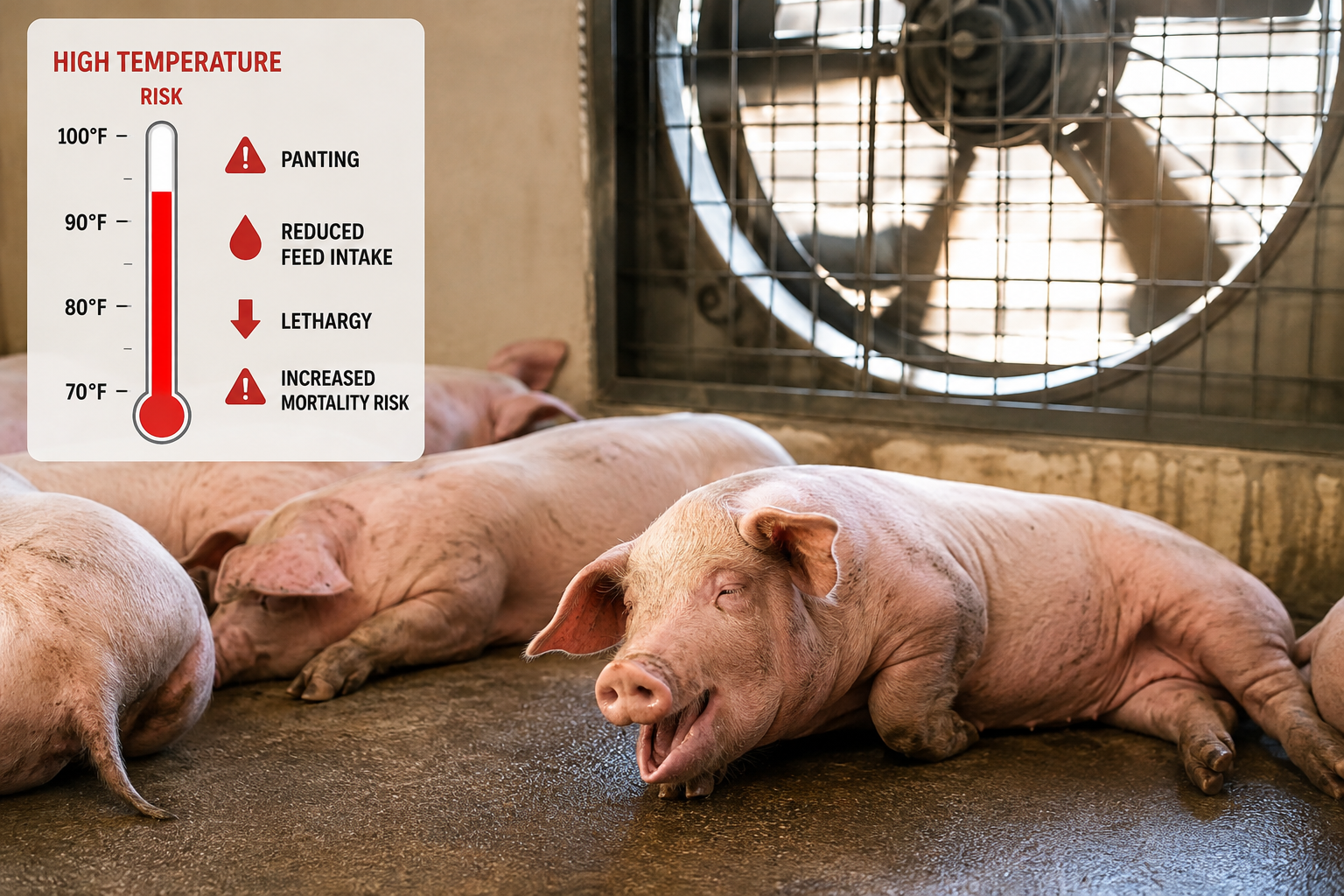
Because of this, their ability to maintain a constant, healthy temperature decreases as they age and gain weight. According to University of Minnesota Extension, heat stress typically begins affecting finishing pigs, sows, and boars once barn temperatures reach approximately 70°F.
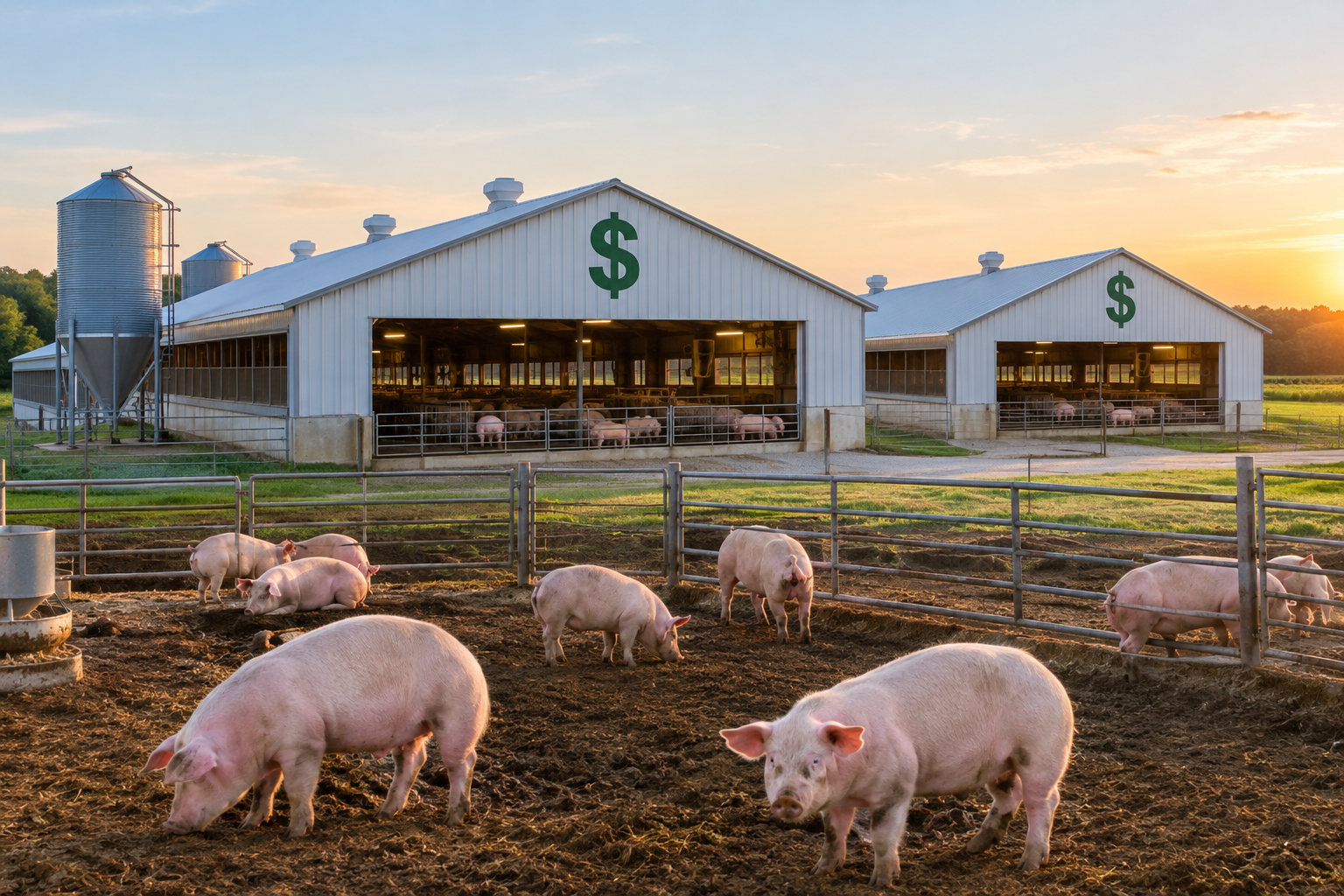
In addition, the financial risk is well documented. University of Minnesota Extension cites an estimate from Dr. Steve Pollmann, formerly Vice President of Smithfield's Hog Production Division, that heat stress costs the U.S. swine industry roughly $900 million annually. He states that this is about an even split between the grow-finish stage and the breeding herd.
A separate, frequently cited academic estimate from St-Pierre and colleagues (2003) put U.S. heat-stress losses at $299 million per year. A 2025 review published in Translational Animal Science took inflation into consideration and found it exceeded $520 million in 2024.
Documented Economic Impact of Heat Stress
| Source | Estimated Annual Loss | Scope |
|---|---|---|
| Dr. Steve Pollmann, cited by UMN Extension | ~$900 million | Total U.S. swine industry |
| St-Pierre et al., 2003 | ~$299 million | U.S. swine industry (2003 dollars) |
| Same estimate, inflation-adjusted (Translational Animal Science, 2025) | >$520 million | U.S. swine industry (2024 dollars) |
Sources: University of Minnesota Extension, "Heat stress in swine affects production"; Translational Animal Science, "Heat stress matters: insights from United States swine producers" (2025), citing St-Pierre et al., 2003.
How Ventilation and Cooling Failures Escalate Quickly
Mechanical ventilation is what keeps the swine within their comfort range. Their low threshold for heat and cold is critical to watch as their sensitivity can be a matter of life and death.
A University of Nebraska-Lincoln Extension swine report said it directly: “a ventilation system failure can kill a large number of animals within just a few minutes.” That is a loss that no farmer can absorb. The report's recommendation is that swine producers would need to install backup systems and a redundancy system that reflects what they are willing to maintain…and lose.
Field surveys provide insights as to why cooling failures are commonplace. A 2025 producer survey published in Translational Animal Science found that most swine operations rely primarily on fans and evaporative cooling pads. The same survey found that 98.1% of respondents ran farrowing-barn ventilation, exhaust fans with adjustable ceilings to keep humidity below 65%, when above temperatures of 68°F.
Water Delivery Failures
Water delivery failures is another issue that farmers need to deal with.
Research published in the peer-reviewed Journal of Swine Health and Production describes salt poisoning, or water deprivation syndrome, as a condition that develops when swine do not have adequate water intake. According to livestock watering-equipment manufacturers, only about 51% of newly weaned piglets consume water within their first 25 hours.
What a Swine Barn Alarm System Does
The swine monitoring system, Agralink, is a wireless alarm and monitoring system monitoring temperature including humidity, feed bins, water flow, power and more with multi-platform access and reliable cellular connectivity.
Wireless Sensors Wireless sensors track barn temperature, humidity, water flow, and feed bin overrun / underrun as well as feed bin levels. Feed level sensors use LiDAR rather than load cells, which improves accuracy on tall or oddly shaped bins. Agralink's feed bin sensors can be retrofitted onto existing bins.
Connectivity and Dashboards Sensor data is constantly collected in real-time to a single online Dashboard. Here, you are able to monitor and track temperature, humidity, ventilation, water flow, and feed data from unlimited locations into one view, accessible from a phone, tablet, or computer.
Alerts and Escalation This critical feature determines whether the system escalates from SMS to an automated voice call. It supports custom call lists so different barns or team members can be reached in a different order or through a different channel. Agralink is built around this type of escalation model, pairing instant SMS and voice alerts with custom call lists.
Testing the System It is recommended to periodically simulate power loss, high-temperature conditions, controller or sensor failure, and communication loss to confirm that the alarm recipients and backup generator actually work as designed. Producers evaluating a platform like Agralink should ask whether this kind of failure simulation and alert-path verification is part of standard setup and ongoing support. Monitoring System Evaluation Checklist
| Feature | Why It Matters |
|---|---|
| SMS & voice alerts | SMS can be missed overnight; a ringing phone is harder to sleep through. |
| Custom call lists per barn | Different barns or shifts often need different escalation paths and contacts. |
| Historical trend data | Surfaces slow equipment degradation — such as a fan losing efficiency — before it becomes an emergency. |
| Exportable reports | Supports recordkeeping and compliance documentation after an event. |
| Dry-contact relay compatibility | Allows retrofit onto existing controllers without full hardware replacement. |
| Battery/cellular backup | Keeps monitoring active during the power outages that ventilation failures often accompany. |
Compatibility note: dry-contact relay systems can typically integrate with common controller brands including AP (EDGE), Phason, Maximus, Chore-Time, Rotem, and Hired Hand.
A Practical Response Protocol for Heat and Ventilation Alerts A farm monitoring system only delivers value if the workers know exactly what to do the moment an alert arrives.
- Acknowledge the alert within minutes so the next person in line is not notified with an alert.
- Check the online Dashboard right on your phone, tablet or desktop to verify the specific barn, sensor, and trend before deciding whether a site visit is needed. Depending on how the alert is set up, a staff member may be only assigned to a single house, where others can be assigned to multiple. This is determined at set up, and can be changed at any time.
- If the staff responsible notices that the reading keeps climbing rather than stabilizing or resolving on its own, action is required.
- Activate pre-identified backup cooling, ventilation, or generator equipment.
- The Dashboard will automatically log the time of notification and acknowledgement.
Frequently Asked Questions At what temperature does heat stress begin affecting swine?
According to University of Minnesota Extension, heat stress typically begins affecting finishing swine, sows, and boars at around 70°F.
How fast can a ventilation failure become fatal? University of Nebraska-Lincoln Extension reports that ventilation system failure can kill a large number of animals within a few minutes, which is why the report recommends backup systems proportional to a producer's acceptable risk level.
How long can swine go without water before it becomes dangerous? Peer-reviewed veterinary literature describes water deprivation syndrome developing within roughly 24 to 48 hours of inadequate water access, with rehydration afterward needing to be reintroduced slowly to prevent brain swelling.
How fast does Agralink alert me when something goes wrong? Agralink sends instant alerts as soon as barn conditions cross a pre-determined threshold. The custom call lists determine who gets notified and in what order for a single or multiple houses. Because ventilation and cooling failures can escalate within minutes, that alert is what separates a barn that catches a problem early to losing a portion to all your assets. If you are interested in learning how an Agralink solution is preventing heat stress losses in swine barns, contact us today!
More Articles
Does the Turkey Alarm System Work During Power Outages?
During the change of seasons, you can count on bad weather to wreak havoc on the electrical system with flickering lights and blinking clocks. What happens to the farm alarm system? Does the turkey alarm system work during power outages? The answer is yes.
Feed Bin Monitoring Gives Growers Control Over their Biggest Cost
Let’s focus on feed bin monitoring. It’s one of the largest investments you’ll make on the farm. Wouldn’t you like to maximize those costs so nothing goes to waste? So we’re all on the same page, let’s first discuss what feed bin monitoring is.
How Much a Swine Farm Can Lose Before an Alarm Goes Off
Learn More About Agralink
See how Agralink's smart farm technology can support your operation.