
Feed Bin Monitoring Gives Growers Real Time Control Over Every Bin
Feed Bin Monitoring for chickens, turkeys, swine
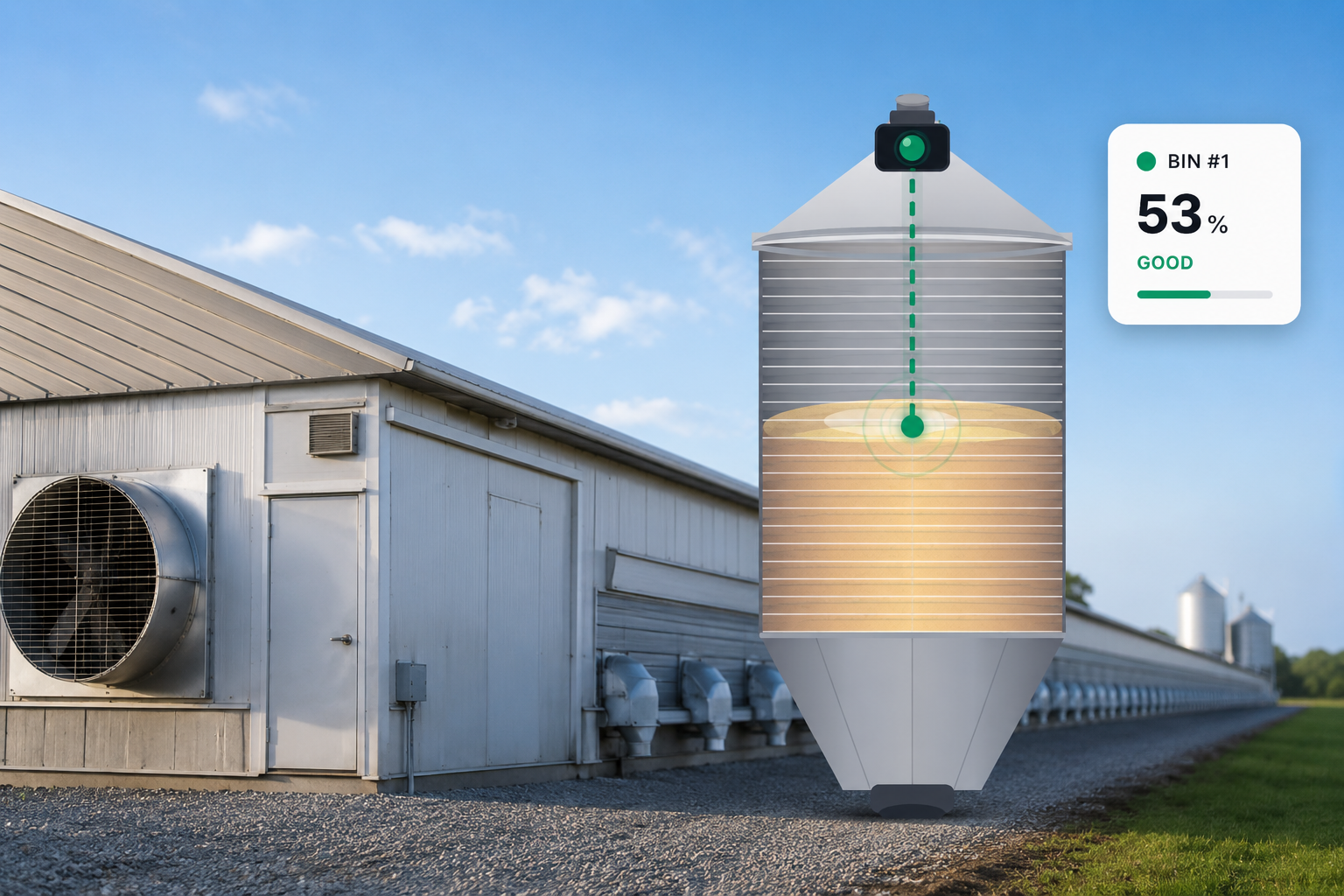
Feed bin monitoring is part of Agralink’s collection of sensors used to monitor, alert and report environmental and feed problems at chicken, swine and turkey farms. The feed bin monitoring system measures in real-time, how much feed is sitting in each bin. The grower can check the Dashboard, on the phone, tablet or desktop, to get notifications as well as accurate data and reporting.
The feed bin monitoring system uses a distance sensing technology, LiDAR, to calculate the volume and weight without physically checking each feed bin. The up-to-date data allows growers to schedule deliveries, avoid outages and cut unnecessary labor costs.
Let’s get into why this matters, and what actually goes on inside the technology that makes it work.
Why Feed Bin Monitoring Matters
Feed is more than a line item on a budget. Research published in the journal Animal Nutrition found that feed represents more than sixty percent of total production cost in swine and poultry operations, with energy alone accounting for a large share of that spend. That single fact explains why feed bin monitoring has become such a priority for growers. When feed accounts for the majority of your operating budget, every small improvement can turn into real financial savings.
There are consequences when a feed bin runs lower than expected and nobody notices until a driver shows up for a routine check. That gap between what a grower assumes is in the bin and what is actually there is exactly the problem Agralink’s feed bin monitoring was built to fix.
Growers using only a single bin can take a quick walk out to the farm. Although the quick check can become an afterthought especially when situations come up and priorities change. If a grower manages a dozen bins across several barns, the grower cannot keep that same level of care without help. That doesn’t mean a person, it can mean technology. That is where a connected sensor, like the feed bin sensor, constantly monitors and alerts if the levels cross the threshold line that the grower sets.
Animal Safety Comes First
Feed outages are a serious issue as it is about the health and welfare of your animals. A feed bin that runs dangerously low can leave an entire barn with minimal or no feed until the next delivery arrives. Feed bin monitoring alerts the grower of falling levels, well before a feed bin empties. This is so a grower has time to react instead of scrambling at the last minute.
Profitability Follows Close Behind
Since feed already eats up most of an operation's budget, any waste or overordering matters. Accurate, real time feed bin data lets growers order exactly what they need, when they need it instead of guessing.
Efficiency Can Change the Daily Routine
Manual bin checks take time. Unnecessary time. Feed bin monitoring removes the need to physically check each bin (even if it’s only one bin), freeing staff for other priority work. Now the grower can simply check the phone, tablet or desktop computer and have a clear picture of usage.
Animal Welfare
Animals fed on a consistent schedule experience less physiological stress. A review in Frontiers in Animal Science noted that significant changes in blood biochemical indices caused by feed restriction show that feed restriction places serious stress on chickens during the growth period. Keeping bins stocked on schedule is one of the simplest ways to avoid that outcome entirely.
How LiDAR Measures Feed Inside the Bin
The technology behind modern feed bin monitoring can be broken down into three steps.
Step One, Distance Measurement
A LiDAR sensor sits at the top of the bin and measures the distance down to the surface of the feed. It does this continuously, without any moving parts touching the feed itself.
Step Two, Volume Calculation
That distance reading gets converted into a volume figure, measured in cubic feet, using the exact geometry and dimensions of the bin it is mounted on. Every bin shape calculates a little differently, so this step has to be tailored to the bin itself.
Step Three, Calibration Applied
Finally, an algorithm applies calibration specific to that operation to turn the volume estimate into a reliable weight figure. This is where raw sensor data becomes something a grower can actually plan around.
Agralink sensors run this entire cycle every five minutes, which means feed bin data on the Dashboard is accurate. The feed bin system works regardless of bin type or layout. This is important because growers do not need to rebuild the infrastructure in order to add feed bin monitoring to an existing site.
Platform Features Built Around Daily Operations
Feed bin monitoring only matters if the data is easy to act on. Agralink built its platform around four features that growers can use every day.
Real time feed alerts notify a grower the moment a bin drops below a set threshold, and again once a delivery restores it to a safe or desired level.
Remote bin setup allows a grower to configure or adjust sensor settings from any location.
Feed bin profile management lets an operation apply consistent parameters across multiple sensors, which matters a lot once a grower scales past a handful of bins.
Automated feed reports turn raw usage data into reports growers can use. Agralink is directly integrated to the MTech system, delivering real-time intelligence to the integrators.
The Agralink feed monitoring system turns feed bin monitoring into an operational planning tool. Instead of reacting to a low bin, growers can start anticipating deliveries days in advance, which gives feed suppliers more lead time for better delivery.
Why LiDAR Beats Load Cells in Feed Bin Monitoring
Load cells have been the traditional solution to feed bin monitoring for many years because they measure weight directly. The table below lays out how the two approaches compare across the factors that matter most to growers.
| Factor | Load Cells | Agralink LiDAR |
|---|---|---|
| Measurement method | Direct weight measurement | Reliable weight estimate |
| Typical installed cost per bin | Ten thousand dollars or more | A fraction of that cost |
| Structural changes required | Yes, structural modifications needed | No structural modifications needed |
| Update frequency | Less frequent updates | Updates every five minutes |
| Power source | Wired power required | One hundred percent solar powered |
For most growers, that combination of lower cost, faster installation, and frequent updates makes LiDAR based feed bin monitoring the more practical choice, especially across operations managing several bins at once.
Integration With MTech Systems
Feed bin monitoring works best when it fits into the tools an operation already relies on. For integrators using MTech, feed bin data syncs directly into the MTech dashboard, giving a grower unified visibility across an entire poultry operation. Learn about Agralink’s integration.
Technical Specifications Growers Ask About Most
Growers want to know what they are buying. Here is what the Agralink feed bin monitoring sensor delivers.
| Specification | Detail |
|---|---|
| Range | 0.1 meters up to 12 meters |
| Power | One hundred percent solar powered |
| Weatherproof rating | IP67 |
| Update frequency | Every five minutes |
| Operating temperature range | Forty degrees below zero Fahrenheit up to one hundred eighty five degrees Fahrenheit |
That IP67 rating means the sensor is sealed against dust and can handle exposure to water. This matters for hardware that lives year round on top of a bin.
Common Questions About Feed Bin Monitoring
What is feed bin monitoring used for?
Feed bin monitoring is used to track how much feed remains in one or multiple bins in real time. This is so growers can plan deliveries, avoid outages, and reduce the labor spent on manual bin checks.
How often does feed bin monitoring update?
Agralink sensors refresh feed bin level data every five minutes. This gives growers a near continuous view of inventory rather than a single daily snapshot.
Does feed bin monitoring require electrical wiring?
No. Agralink sensors run on solar power, which removes the need for wired electrical installation and makes setup faster across remote bin locations.
Is feed bin monitoring accurate across different bin shapes?
Yes. The system applies bin specific geometry and operation specific calibration, so the same sensor technology adapts to different bin types and layouts.
The Bottom Line on Feed Bin Monitoring
Feed bin monitoring gives growers a way to manage that cost with real data which protects the health and well being of the animals. Growers who want to see how this fits their own operation can get a quote today.
More Articles
Does the Turkey Alarm System Work During Power Outages?
During the change of seasons, you can count on bad weather to wreak havoc on the electrical system with flickering lights and blinking clocks. What happens to the farm alarm system? Does the turkey alarm system work during power outages? The answer is yes.
Feed Bin Monitoring Gives Growers Control Over their Biggest Cost
Let’s focus on feed bin monitoring. It’s one of the largest investments you’ll make on the farm. Wouldn’t you like to maximize those costs so nothing goes to waste? So we’re all on the same page, let’s first discuss what feed bin monitoring is.
How Much a Swine Farm Can Lose Before an Alarm Goes Off
Learn More About Agralink
See how Agralink's smart farm technology can support your operation.